Soluble quick-release electron donor
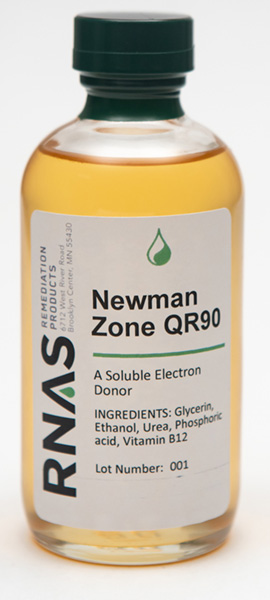
Newman Zone QR90
High Hydrogen Production, Low Cost
Newman Zone QR90 is a blend of soluble electron donors, nutrients, and vitamins designed to rapidly establish anaerobic conditions for in situ bioremediation. With 90% fermentable material, it produces up to three times more molecular hydrogen than sodium lactate.
Rapid fermentation provides hydrogen to quickly reduce competing electron acceptors such as dissolved oxygen, nitrate, and sulfate, creating conditions favorable for anaerobic biodegradation of chlorinated solvents, nitrated explosives, perchlorate, nitrate, and selected metals.
Why Newman Zone QR90
Newman Zone QR90 is designed for rapid response. As a soluble electron donor, it distributes quickly in groundwater and begins fermenting immediately, making it effective for quickly establishing anaerobic conditions and stimulating microbial activity.
With high hydrogen production relative to traditional soluble donors such as sodium lactate, QR90 delivers more usable electron donor per pound injected, improving overall treatment efficiency.
For projects requiring both rapid startup and long-term treatment, Newman Zone QR90 can be combined with slow-release donors such as Newman Zone 55 or Newman Zone HRO.
Cost-Effective Hydrogen Production
Produces up to 3X more molecular hydrogen than sodium lactate, improving efficiency per pound of donor.
Rapid Microbial Growth
Provides electron donors, nitrogen, phosphorus, and Vitamin B12 to support fast microbial activity.
No Sodium Salts
- Ideal for salt-sensitive aquifers where sodium lactate is not an option.
Performs in Cold Conditions
Low viscosity and will not freeze, remaining pumpable even at -75ºC.
Technical Details
How it Works
1. Distributes Rapidly in Groundwater
As a soluble donor, QR90 disperses quickly throughout the treatment zone following injection.
2. Ferments to Produce Hydrogen
Rapid fermentation generates hydrogen and volatile fatty acids, reducing competing electron acceptors such as DO, nitrate, and sulfate.
3. Stimulates Anaerobic Biodegradation
The resulting conditions support reductive dechlorination and other anaerobic biodegradation processes.
Application & Handling
- Diluted with water prior to injection
- Can be applied using direct push, injection wells, infiltration trenches, or recirculation systems
- Ethanol concentrations are typically kept below 5% in situ to minimize microbial toxicity
- Can be injected directly into wells to help reduce biofouling on screens
Performance Characteristics
- Rapid fermentation produces hydrogen and VFAs quickly
- Sustains higher VFA concentrations compared to sodium lactate in microcosm testing
- Effective for quickly reducing electron acceptors and initiating treatment
Packaging & Storage
Available in:
- Drums (450 lb net)
- Totes (2,200 lb net)
Storage:
- Stable for months at ambient temperatures
- Remains pumpable in sub-zero conditions
- Will not freeze above -75°C
Safety
- Flammable liquid at room temperature
- May cause irritation with prolonged contact
- Use appropriate PPE during handling
- Contains denatured ethanol (SDA-3C)
QR75 / QR90 Comparison
| Feature | QR75 | QR90 |
|---|---|---|
| Fermentable Material | ~75% | ~90% |
| Hydrogen Production | ~2X sodium lactate | ~3X sodium lactate |
| Performance Profile | Cost-efficient hydrogen delivery for general applications | Higher hydrogen delivery for faster reduction of electron acceptors |
| Response Speed | Rapid (days) | Very rapid (near-immediate fermentation) |
| Temperature | Pumpable to -30°C | Pumpable to -75°C |
Need to quickly establish anaerobic conditions?
Get guidance on dosing, injection strategy, and combining QR90 with long-term electron donors.